19 November 2026
China – How did China become the world’s manufacturing powerhouse?
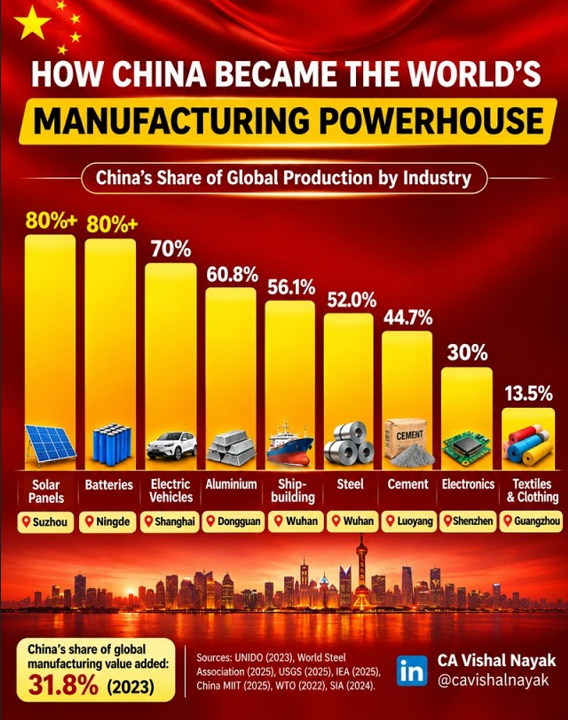
The story began in 1978, when Deng Xiaoping introduced economic reforms and opened China to foreign investment and global trade.
But the real transformation happened over the next few decades.
China invested heavily in roads, ports, industrial parks and factories. It attracted global companies, developed supplier networks and made large-scale manufacturing easier.
It also developed specialised industrial cities:
- Shenzhen: Electronics and technology
- Shanghai: Automobiles and finance
- Dongguan: Electronics manufacturing
- Guangzhou: Automobiles and textiles
- Suzhou: Machinery and industrial manufacturing
- Hangzhou: E-commerce and technology
These cities helped create a strong manufacturing ecosystem.
At the same time, companies such as Huawei, BYD, Xiaomi, Lenovo, Alibaba and CATL grew into global players.
Today, China manufactures everything from smartphones and electric vehicles to solar panels, batteries, machinery and textiles.
In 2024, machinery and electrical equipment accounted for around 47.4% of total exports. Textiles contributed around 7%, vehicles and related transport products around 7%, and chemicals around 6%.
What can we learn from China’s journey?
China didn’t become a manufacturing giant simply by building more factories. It connected infrastructure, suppliers, technology, skilled workers and businesses into one powerful ecosystem.
That is perhaps the biggest lesson for India.
Building factories is important. Building an ecosystem around them is even more important.
Source: https://www.linkedin.com/in/cavishalnayak/