
27 April 2026

At this year’s Materials+, PEELSPHERE was unmistakably one of the show’s most talked-about booths. From its presentation and steady flow of on-site conversations to the buzz generated by its NextGen Fashion Material TechTalk appearance, it became a stand visitors stopped at—and often came back to.
In the world of next-generation materials, the hardest part is no longer coming up with a sustainability concept. The harder task is turning a material into something that can actually move through product development, supply chains, and real market applications. For brands, a material’s bio-based credentials matter. But the more practical questions never go away: Can it pass testing? Can it be supplied consistently? Can it meet the performance demands of different application scenarios? And, ultimately, can it win market acceptance?
PEELSPHERE is one of the brands being noticed precisely because it is trying to answer those questions.
According to the brand, PEELSPHERE uses fruit waste, algae, and other plant-based feedstocks as raw materials, then applies material engineering to develop multiple material series for applications ranging from fashion and accessories to home furnishings, consumer electronics, and automotive interiors. The company emphasizes performance, traceability, and design aesthetics, and has developed lines including Algaeskin, Bestwaste, and Celtex. These elements outline not just a materials startup, but a brand attempting to push bio-based materials from concept into more demanding applications.

When you first founded PEELSPHERE, what market problem were you trying to solve?
The starting point was very simple and direct. When I was studying in Germany, I could not find a material on the market that was both bio-based and high-performance. That was not just frustrating for designers; it also reflected a structural gap in the materials market.
Many so-called sustainable alternatives came with compromises in functionality and aesthetics. What I wanted to solve was exactly that gap: to create a bio-based material that combines environmental value, strong practical performance, traceability, and a high level of aesthetic quality—something that could truly be used in everyday life.
What do you see today as PEELSPHERE’s most fundamental point of difference?
At the core of PEELSPHERE is our proprietary technology. It allows us to create a material system that is friendly to people, animals, and the planet, while also delivering strong functionality, full-chain traceability, and a refined aesthetic quality. At the same time, it can create new growth opportunities for the brands we work with. Those five strengths together define our differentiation.
PEELSPHERE materials come from fruit waste, algae, and other plant-based inputs. In simple terms, how do those materials become something usable for products?
First, we collect non-food agricultural waste such as coffee husks, banana peels, and orange peels, then clean them to remove sugars, pigments, proteins, oils, and other impurities, leaving behind only the base plant cellulose. We then use our patented technology to process that cellulose down to the micro- and nano-scale, extracting high-strength nanocellulose.
After that, we combine those nanofibers with natural bio-based binders, such as algae extracts, and use a specialized forming process to create sheet materials. Finally, these base materials go through natural dyeing, embossing, laser cutting, and other finishing processes to become bio-based materials with different textures, colors, and tactile qualities that brands can use directly.
So the key is not simply recycling waste, but converting it into a material that can actually be designed, processed, and applied?
Exactly. What we are trying to do is not just turn waste into raw material. We use technology to convert it into a material with stability, processability, and application value—something brands can genuinely use, rather than treat as a concept.
PEELSPHERE currently includes several material series, including Algaeskin, Bestwaste, and Celtex. What does each one represent?
Algaeskin is our algae-based leather series, and it is also the most visually distinctive. It is the world’s first 100 percent biobased, semi-transparent biotech material, developed from algae. It has a unique texture and visual quality, making it especially suitable for haute couture, fine jewelry, avant-garde fashion brands, and large-scale art installations that require a strong sense of design.
Bestwaste is currently the most commercially developed series. It has a stronger leather-like feel, stable performance, strong durability, and traceable raw materials. It is particularly well suited to bags, footwear, automotive interiors, consumer electronics accessories, and home applications where durability and brand storytelling both matter.

Celtex is the latest upgrade built on our Bestwaste technology. As a high-performance plant-fiber material with a high bio-based content, it has a finer texture and handfeel, and can closely simulate—or even surpass—the tactile qualities of traditional leather. It is aimed specifically at fields such as automotive interiors and premium home furnishings, where durability, touch, and aesthetics all need to meet a very high standard.
If you had to sum it up in one line: Algaeskin is about design expression, Bestwaste is the most commercialized today, and Celtex represents the next step in performance?
Yes. Algaeskin and Bestwaste have both already passed comprehensive testing by the EU and leading global luxury brands. Celtex best represents the next stage of our development, because it pushes the performance boundary of bio-based materials to a higher standard—one that can meet the more demanding requirements of industrial applications such as automotive and high-end home furnishings.
For next-generation materials, performance and scale are always central questions. What do you see as PEELSPHERE’s strongest material advantage today?
Our biggest advantage is that we have broken through the usual impossible triangle of bio-based materials: high performance, low cost, and scalable mass production. We have achieved a workable balance across all three. In terms of performance, our materials are comparable to traditional leather in abrasion resistance, hydrolysis resistance, and color fastness. In some areas, such as resistance to deformation and resilience, they can even outperform certain traditional leathers. At the same time, they are lighter, softer, and more durable.
In terms of traceability, we have established what we describe as the world’s first transparent production line for plant-fiber materials in Shenzhen Guangming Science City, enabling 100 percent end-to-end traceability from raw material procurement to finished product. Brands can clearly trace where each material comes from and how it has been processed. That gives clients a stronger basis for ESG reporting and sustainability storytelling.
Which applications would you say are already truly market-ready?
The areas that are already genuinely market-ready include bags and leather goods, footwear, fashion apparel and accessories, consumer electronics accessories, and automotive interiors. Our production capacity and efficiency are also increasing rapidly, allowing us to meet larger-scale market demand.
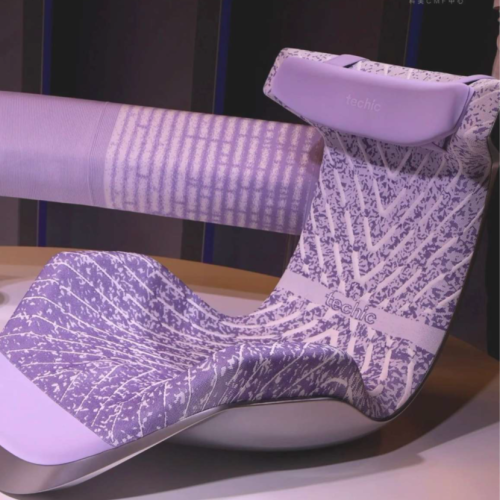
Toyota’s automotive seats made with PEELSPHERE bio-based materials made their debut at Auto Shanghai 2025.
When you speak with brands and product development teams, what proof points matter most to them?
What brands care about most is a full proof system, not a single metric. Usually, the first thing they look at is authoritative certification. Our materials have received the EU’s TÜV OK BIOBASED four-star certification, which is a basic threshold for entering the supply chain of international luxury brands.
The second is comprehensive testing data. We have passed extensive and highly demanding testing by the EU and multiple leading global luxury brands across material content, performance, and end-use requirements. The third is mass-production and delivery capability, because brands need to know the material can be supplied consistently. We achieved our first scaled deliveries in 2024 and established a transparent, traceable production line.
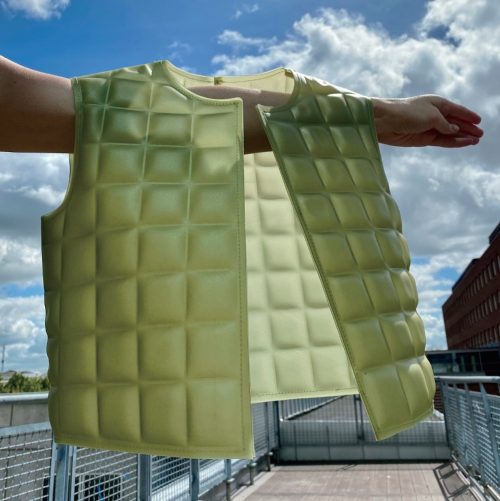
PEELSPHERE created a custom sustainable bio-based vest for Balenciaga.
Beyond certification, testing, and delivery—does aesthetics still remain a decisive factor?
Absolutely. Aesthetic expression is one of our key differentiators. We have developed more than 200 unique surface and design techniques, including full-color rippled translucency and three-dimensional sculptural textures. The traceability of the raw material story is also becoming increasingly important. Our feedstocks come from recognizable sources such as Starbucks and Guizhou Zhenjiu, which helps brands build a more persuasive sustainability narrative.
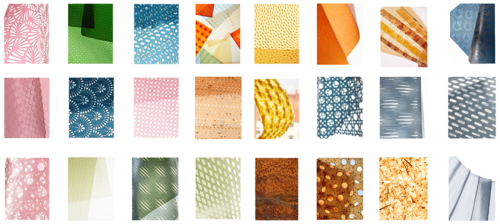
One thing that stands out immediately is how polished PEELSPHERE’s communication feels. Not just the materials themselves, but the design language, the use of color, and the storytelling all feel highly intentional. Is that part of the aesthetic philosophy you want PEELSPHERE to express—not just making materials, but making materials that can carry emotion, narrative, and beauty?
Yes. From the beginning, we never saw PEELSPHERE as just a material supplier. We wanted the material itself to carry story and aesthetics. The Chinese name, the overall visual language, and the short films are all part of making the idea of waste regeneration something people can actually feel and connect with.
We do not believe sustainable materials have to look plain or emotionally flat. They can be beautiful. They can carry atmosphere and emotion. That has always been something we value alongside product development.
What brought PEELSPHERE to Materials+ in the first place?
The core reason we joined Materials+ is that the APLF platform is a professional event deeply rooted in the leather sector, while also placing strong emphasis on innovative materials and next-generation bio-based materials. That aligns closely with our brand positioning.
We came hoping to meet three groups in particular: international fashion brands and luxury groups with purchasing power, so we could deepen supply-chain collaboration; materials buyers from the automotive and consumer electronics sectors, to help move the material into higher-performance applications; and ecosystem partners and fellow innovators, to discuss industry standards and pathways to scale.
In what ways did the show meet—or exceed—your expectations?
It definitely exceeded our pre-show expectations in three main ways. First, the buyer profile was more diverse than expected. In addition to the fashion and luxury sectors we already knew well, we also met professional buyers from automotive, consumer electronics, and premium home fields. That aligned directly with our strategy of expanding into higher-performance application scenarios.
Second, the depth of the conversations improved significantly. Instead of broad exploratory discussions, many of the brands we met came with specific technical requirements and project plans. That made communication during the show much more efficient.
Third, the market signal itself was very positive. You could clearly feel that the conversation was no longer “Why should we use this?” but “How do we use this well—and fast?” That change in attitude gave us much more confidence about the next stage of scaling.
Does that suggest the market’s attitude toward materials like this is changing?
Yes. That shift in mindset is something we felt very strongly. For us, it is a clear signal that high-performance bio-based materials are moving into a more practical stage of market discussion.
You also participated in NextGen Fashion Material TechTalk. How was that different from what happened at the booth?
Booth conversations are more like point-to-point business discussions. They are usually centered on samples, application cases, and specific collaboration needs. TechTalk, by contrast, is a platform for deeper narrative and value communication. It gave me the chance to tell the full arc of our innovation story—from why we started doing this, to how we achieved the technical breakthroughs, to how the material can create value for brands.
Did that format help people understand PEELSPHERE more deeply?
Yes. At TechTalk, I was able to clearly explain how a fruit peel can be transformed from waste into a high-end material, instead of condensing the story into a few minutes at the booth. After the talk, many people came back for deeper conversations, and their questions were noticeably more professional and more specific. That kind of shift—from surface-level curiosity to real understanding—is exactly what makes a format like TechTalk so valuable.
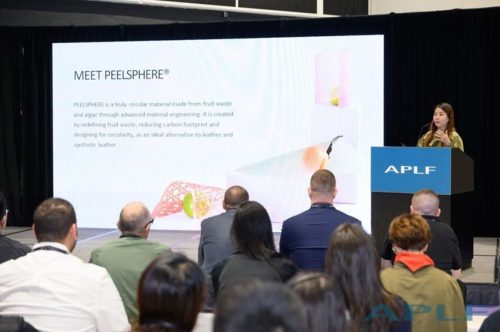
From the response at Materials+, PEELSPHERE was not simply another innovative materials brand drawing attention. It had become one of the show’s most closely watched booths. And when the conversation starts shifting away from abstract material ideals and toward application methods, technical requirements, and realistic collaboration pathways, that attention means something more. It suggests PEELSPHERE is moving into a more practical—and more demanding—stage of market dialogue.