
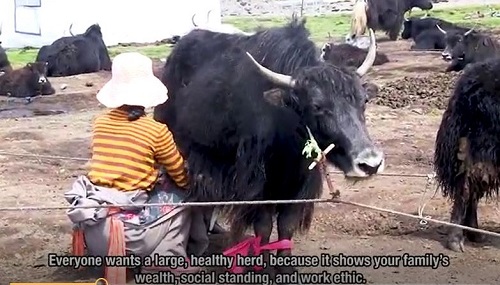
 Yak keeping is closely bound up with the social and cultural life of the people, most particularly in the vast rangeland grazing areas of the Qinghai-Tibetan Plateau and other parts around the Himalayan Mountain range. The yak is, moreover, a component of the religious practices and manifestations of Tibetan Buddhism.
Yak production underpins the economy of much of this region. To meet the challenges of a harsh and often unfriendly environment on the “roof of the world”, herders have developed a complex system of management and land use involving the sharing of grazing lands and their use, for the most part in a nomadic fashion resulting in rotational use of the grazing lands. Much of this developed through agreements between families and within villages. Traditionally, pastoralists relied on their yak primarily for subsistence, but status was also conferred by possessing large numbers of yak. With the more recent moves towards a market-oriented economy, changes have been imposed or at least suggested that affect both the traditional patterns of yak keeping and the purpose of keeping the animals.
Watch video:
Yak keeping is closely bound up with the social and cultural life of the people, most particularly in the vast rangeland grazing areas of the Qinghai-Tibetan Plateau and other parts around the Himalayan Mountain range. The yak is, moreover, a component of the religious practices and manifestations of Tibetan Buddhism.
Yak production underpins the economy of much of this region. To meet the challenges of a harsh and often unfriendly environment on the “roof of the world”, herders have developed a complex system of management and land use involving the sharing of grazing lands and their use, for the most part in a nomadic fashion resulting in rotational use of the grazing lands. Much of this developed through agreements between families and within villages. Traditionally, pastoralists relied on their yak primarily for subsistence, but status was also conferred by possessing large numbers of yak. With the more recent moves towards a market-oriented economy, changes have been imposed or at least suggested that affect both the traditional patterns of yak keeping and the purpose of keeping the animals.
Watch video: